

Investing in the stock market is within everyone's reach, regardless of their background or location. Anyone with a smartphone, an internet connection, and a “trading account” can buy and sell shares from anywhere in India. With that said, understanding the basics of a trading account is essential for every new investor.
A trading account is a basic requirement for participating in the stock market. Whether you want to invest in shares, apply for IPOs, or trade in different market segments, a trading account acts as the link between your bank account and the stock exchange.
In this guide, we'll explain what a trading account is, how it works, the different types available in India, the growing role of AI in stock market trading, and the process to open a trading account online. We'll also cover safety tips, compliance requirements, and answer some of the most common questions asked by beginners.
Trading Account Meaning
A trading account is a specialized account that allows investors and traders to buy and sell financial securities such as stocks, exchange-traded funds (ETFs), bonds, commodities, currencies, and derivatives through recognized stock exchanges.
In simple terms, a trading account acts as a connection between your bank account and the stock market.
When you place a buy order, money is debited from your bank account through the trading platform.
When you sell shares, the proceeds are credited back after settlement.
The trading account definition can be understood as an electronic interface provided by a registered broker that allows investors to place orders on stock exchanges such as the National Stock Exchange (NSE) and the BSE.
Think of it this way:
- Bank Account = Stores your money
- Demat Account = Stores your securities
- Trading Account = Helps you buy and sell securities
For example, suppose Ramesh from a small town in Maharashtra wants to purchase 10 shares of a company trading at ₹1,000 per share. He cannot directly call the stock exchange and buy shares. Instead, he places an order through his trading account. The broker sends the order to the exchange, and once executed, the shares are credited to his Demat account.
This is why understanding a trading account is one of the first steps toward participating in the stock market.
How Does a Trading Account Work?
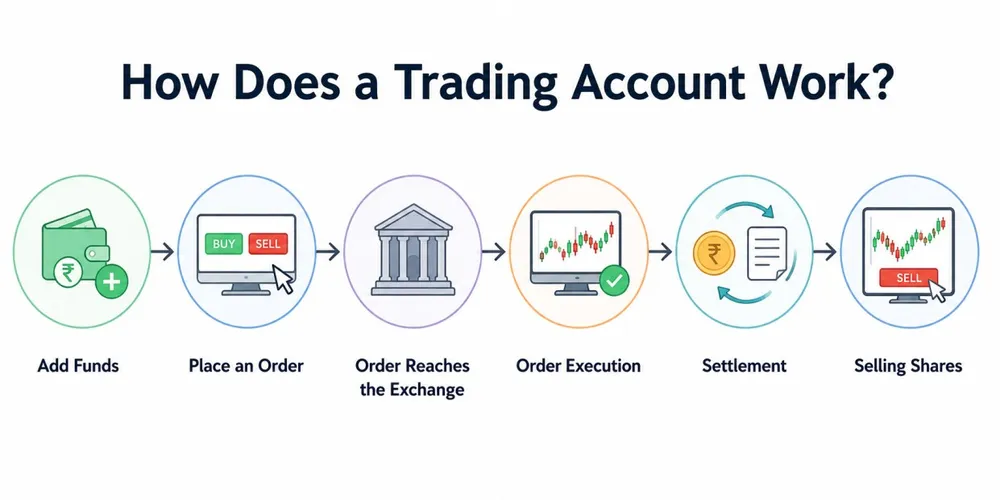
A trading account works as a digital gateway between investors and stock exchanges. Although the process happens within seconds, several systems work together behind the scenes.
Let's understand with a practical example.
Imagine Priya wants to invest ₹20,000 in shares of a listed company.
Step 1: Add Funds
Priya transfers ₹20,000 from her bank account to her trading account.
Step 2: Place an Order
Using her broker's website trading platform or mobile app, she selects the stock and places a buy order.
Step 3: Order Reaches the Exchange
The broker forwards the order to the stock exchange where matching buyers and sellers are available.
Step 4: Order Execution
Once a matching seller is found, the trade is executed.
Step 5: Settlement
The purchased shares are transferred to Priya's Demat account as per the settlement cycle.
Step 6: Selling Shares
When Priya decides to sell, she places a sell orders through the same trading account. Once the trade is completed, the sale proceeds are credited back.
Numerical Example
Suppose:
- Investment Amount = ₹50,000
- Share Price = ₹500
Number of Shares Purchased:
₹50,000 ÷ ₹500 = 100 Shares
If the share price rises to ₹600:
100 × ₹600 = ₹60,000
Potential Gain = ₹10,000 (excluding taxes and charges)
This simple example demonstrates how a trading account facilitates transactions while maintaining transparency and regulatory oversight.
Also Read - What is Future and option
AI in Trading Account

Technology is rapidly transforming investing, and one of the biggest developments is the growing use of AI (Artificial Intelligence) in stock market trading.
Typically, Artificial Intelligence can help analyse large volumes of market data, identify trends, detect unusual trading activity, and provide insights that may support investment decisions.
Today, many brokers integrate AI-powered features into their trading platforms, including:
- Market trend analysis
- Smart watchlists
- Portfolio insights
- Risk assessment tools
- Automated alerts
- Pattern recognition
- News sentiment analysis
For example, if a stock suddenly experiences higher-than-normal trading volumes, AI systems may identify the activity and alert investors.
However, investors should understand an important aspect: AI in share trading is a decision-support tool, not a guarantee of profits.
Stock markets are influenced by economic conditions, company performance, government policies, global events, and investor sentiment. No AI model can accurately predict market movements all the time.
AI can make market research faster and more accessible, but investment decisions should always be guided by proper analysis, financial goals, and individual risk tolerance.
Types of Trading Account
Different investors have different goals. As a result, brokers offer multiple types of trading accounts.
Equity Trading Account
Used for buying and selling shares listed on stock exchanges.
Best for:
- Retail investors
- Long-term investors
- Swing traders
Commodity Trading Account
Used for trading commodities such as:
- Gold
- Silver
- Crude Oil
- Natural Gas
- Agricultural commodities
Derivatives Trading Account
Allows trading in:
- Futures
- Options
Generally used by experienced traders for hedging and speculation.
Margin Trading Account
Provides additional buying power through broker-funded leverage.
Suitable for:
- Active traders
However, leverage increases both profits and losses.
Online Trading Account
The most common type today.
Features include:
- Mobile trading
- Real-time market data
- Instant fund transfer
- Portfolio tracking
- Research reports
Benefits of Trading Account
A trading account offers several advantages beyond simply buying and selling shares.
Easy Market Access-
Investors can access financial markets from anywhere using a smartphone or computer.
Faster Transactions-
Orders are executed electronically within seconds.
Transparency-
Investors can track order status, holdings, transaction history, and profits or losses in real time.
Portfolio Monitoring-
Most platforms provide portfolio tracking and performance analytics.
Access to Multiple Investment Products-
Many brokers offer access to:
- Equities
- ETFs
- IPOs
- Bonds
- Mutual funds
- Commodities
- Derivatives
Lower Costs-
Compared to traditional offline trading methods, online platforms have significantly reduced transaction costs.
Trading Account vs Demat Account
One of the most common beginner questions is understanding the difference between a trading account and a Demat account.
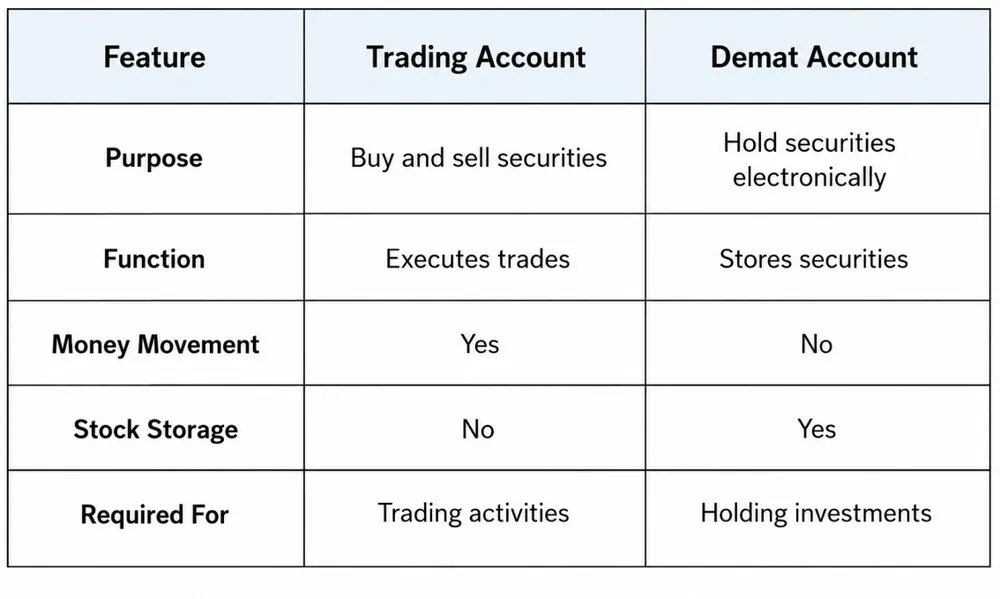
Think of the trading account as the vehicle and the Demat account as the parking space where your shares are stored after purchase.
Also Read - What is Demat Account
Trading Account Compliance
In India, trading accounts operate under strict regulatory oversight.
Key regulatory bodies include:
- Securities and Exchange Board of India (SEBI)
- National Stock Exchange (NSE)
- BSE
- Central Depository Services Limited (CDSL)
- National Securities Depository Limited (NSDL)
Compliance requirements typically include:
- PAN verification
- Aadhaar verification
- KYC completion
- Bank account linking
- Mobile number verification
- Email verification
Investors should always choose brokers registered with SEBI.
Who Should Open a Trading Account?
A trading account can be useful for:
- First-time stock market investors
- Salaried professionals
- Business owners
- College graduates starting wealth creation
- Long-term investors
- Active traders
- Retired individuals seeking investment opportunities
Even if you plan to invest small amounts such as ₹500 or ₹1,000 per month, having a trading account can help you participate in India's growing capital markets.
Procedures to Open a Trading Account Online
Opening a trading account in India has become significantly easier.
Step 1: Choose a SEBI-Registered Broker
Research brokerage charges, platform features, customer support, and investment options.
Step 2: Complete Online Registration
Provide:
- Name
- PAN
- Mobile number
- Email ID
Step 3: Complete KYC
Submit required documents digitally.
Step 4: Link Bank Account
Add your primary bank account for fund transfers.
Step 5: Verification
Complete OTP and identity verification.
Step 6: Account Activation
After successful verification, the trading account is activated.
In many cases, the entire process can be completed within a few hours.
Documents Required & Trading Account Safety
Generally, investors need:
- PAN Card
- Aadhaar Card
- Passport-size photograph
- Bank account proof
- Signature
Trading Account Safety Tips
Unfortunately, rising participation in the stock market has also led to an increase in trading scams.
To protect yourself:
- Use only SEBI-registered brokers.
- Enable two-factor authentication.
- Never share OTPs.
- Verify investment tips independently.
- Avoid guaranteed-return schemes.
- Regularly monitor account activity.
- Keep passwords strong and unique.
A secure trading account helps protect both your funds and investments.
Conclusion
Understanding the trading account meaning is the foundation of stock market participation, as a trading account serves as the gateway to buying and selling securities.
With digital platforms, simplified account opening procedures, and innovations such as AI in stock market trading, investing has become more accessible than ever before. However, investors should focus on education, compliance, and safety while building their investment journey.
Before you open a trading account, compare brokers carefully, understand the associated costs, and ensure the platform aligns with your financial goals. A well-chosen trading account can become an important tool in your long-term wealth-building strategy.
FAQs
Which platforms offer direct equity trading in India and what should I look for in a broker?
Several brokers provide direct equity trading facilities in India. While choosing a broker, investors should evaluate brokerage charges, platform stability, research tools, customer support, security features, order execution speed, and regulatory compliance. Ensure the broker is registered with SEBI and provides transparent pricing.
Which platforms support screen-based trading in India and how reliable are they?
Most modern brokers offer screen-based trading through web platforms and mobile applications. Reliability depends on factors such as system uptime, order execution quality, cybersecurity measures, and customer service. Investors should review platform performance and user feedback before opening an account. We at Choice FinX provide screen based trading for India share market.
Which online trading apps would you recommend for beginners who want to trade stocks and forex?
Beginners should prioritize ease of use, educational resources, transparent charges, and strong customer support. Before trading forex or derivatives, investors should understand the associated risks and ensure the broker offers access to products permitted under Indian regulations. We Choice FinX is all‑in‑one trading app for Stocks, Mutual Funds, IPO
What's the best way for a complete beginner to start trading stocks today?
The best approach is to first understand market basics, open a trading account with a SEBI-registered broker, complete KYC formalities, learn how orders work, start with small investments, and focus on risk management. Building knowledge gradually is often more effective than chasing quick profits.
Disclaimer: This article is for educational and informational purposes only and should not be considered investment, financial, or trading advice. Investments in securities are subject to market risks. Always conduct your own research and consult a qualified financial advisor before making investment decisions.
Related Blog

Key Takeaways * An ETF holds a basket of securities and trades on a stock exchange like a share. * Most ETFs in India are passively managed — they aim to copy an index, a commodity like gold or another benchmark, rather than try to beat it. * Returns can differ a little from the benchmark, because of expenses, cash holdings, transaction costs, portfolio adjustments and the fund’s replication method. * You need a demat and trading account to buy and sell ETF units. * ETFs are generally low-
13 October 2026

Nifty Prediction For Tomorrow Nifty closed at 22,363.35, down 157.10 points (-0.70%). The index opened higher at 22,593.20, around 72 points above the previous close, and initially touched an intraday high of 22,651.10. However, selling pressure emerged soon after the opening and persisted through most of the session. Nifty declined to an intraday low of 22,304.45 before recovering slightly to close at 22,363.35, reflecting continued weakness and a lack of sustained buying interest at higher le
11 October 2026

Natural Gas Price Prediction for Next Week (12th October - 16th October 2026) Support 2 Support 1 CMP Resistance 1 Resistance 2 285.30 302 313.70 318.80 330 NYMEX Natural gas prices rallied 7%, driven by heightened supply fears as escalating Iranian attacks on commercial vessels in the Strait of Hormuz threatened global energy transit. Additional upward momentum stemmed from Category 3 Hurricane Isaias threatening the US Gulf Coast, though price impacts tempered after it weakened to
10 October 2026
Made for Traders.
Trusted by Investors.
Download FinX — trade confidently, invest
smarter, track everything.
Table of Contents

- Trading Account Meaning
- How Does a Trading Account Work?
- AI in Trading Account
- Types of Trading Account
- Benefits of Trading Account
- Trading Account vs Demat Account
- Trading Account Compliance
- Who Should Open a Trading Account?
- Procedures to Open a Trading Account Online
- Documents Required & Trading Account Safety
- Trading Account Safety Tips
- FAQs